
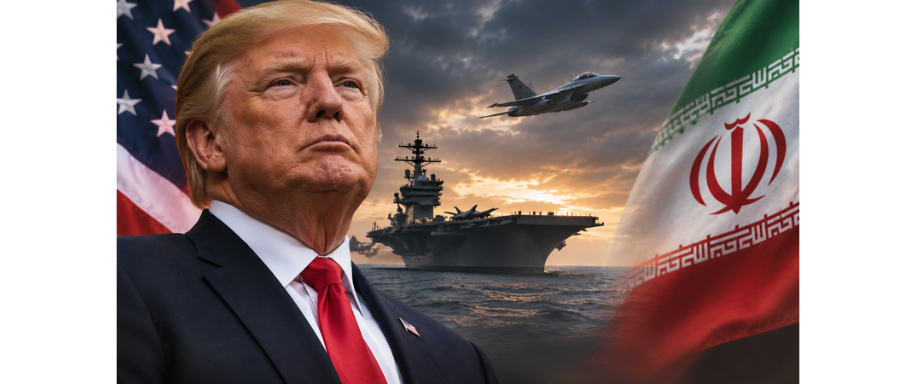
Trump Rules Out Immediate Major Strike on Iran, Says US Forces Remain ‘Locked and Loaded’
US President Donald Trump has sought to ease concerns about an immediate escalation into a full-scale military conflict with Iran, stating that Washington is satisfied with the current developments while keeping its military forces ready to respond if required.
In an interview with the Financial Times on Tuesday, Trump said the United States was achieving its objectives through the ongoing confrontation. His comments followed confirmation of a limited American strike against an Iranian military installation near the strategically significant Strait of Hormuz.
During the six-minute telephone conversation, Trump indicated that the United States was not currently considering another large-scale military operation against Iran.
“We seem to be getting everything we want,” he told the newspaper.
Responding to reports that Israeli Prime Minister Benjamin Netanyahu had suggested a possible attack later this week, Trump stressed that American forces remained prepared for further action.
“I’m ready, we’re ready. We’re locked and loaded if we need to go, but there may be no reason for it,” he said.
Trump characterized the current US position as a “brilliant situation”, claiming that oil shipments passing through the Strait of Hormuz had increased compared with the period before the war. He also argued that Washington’s blockade of Iranian ports was creating significant economic pressure on Tehran.
The president further attempted to downplay the intensity of the confrontation, saying the United States was not “really” at war with Iran.
“I don’t consider that we’re in war like Ukraine, wars like World War I, World War II,” Trump added.
Although he refused to discuss possible future military operations, Trump indicated that diplomatic discussions with Tehran were still underway.
US Carries Out Limited Strike on Iranian Military Installation
Trump confirmed the latest American military operation during an interview with Fox News, following reports that US forces had targeted an Iranian facility on Qeshm Island, located in the Strait of Hormuz.
According to Trump, the operation targeted an anti-aircraft installation that had recently been completed.
“They built an anti-aircraft facility… As soon as it was completed, we hit it last night very nicely,” he said during the Fox & Friends programme.
Describing the operation as a “minor attack”, Trump confirmed the strike. Meanwhile, an Israeli military spokesperson told AFP that Israel had no involvement in the reported operation.
The development came only hours after Trump indicated that a potential agreement with Tehran remained possible, shortly before voting commenced in the US midterm elections.
The elections were being viewed as an important measure of Trump’s political support, particularly amid growing public concerns about the Iran conflict and rising inflation.
In the days before the vote, Trump had continued issuing warnings to Tehran. On Sunday, he suggested that Washington might eventually have to give Iran “the hammer”, without specifying when such action could take place.
He had also previously indicated that one or two remaining targets required attention, including the location known as Pickaxe Mountain in central Iran. Washington suspects the site may be associated with Iran’s nuclear programme, a claim that Tehran has consistently rejected.
Iran Signals Readiness to Respond to Any Renewed Military Action
Iranian officials have responded to the latest developments by reiterating that the country remains prepared to defend itself against any renewed American military operation.
Mohammad Bagher Ghalibaf, Iran’s chief negotiator in discussions with Washington, declared that the Islamic Republic was “ready for battle with its finger on the trigger”.
Iranian Deputy Foreign Minister Kazem Gharibabadi also emphasized that Tehran maintained its right to “legitimate self-defence” following the recent attacks.
Ghalibaf further stated that Iran had already communicated its position clearly, placing responsibility on Washington to prevent another military confrontation.
“The ball is now in America’s court to prevent war,” he said.
At the same time, Iranian President Masoud Pezeshkian indicated that his administration continued to pursue a diplomatic solution to the ongoing crisis.
He cautioned that a renewed conflict would bring benefits to neither side, warning that “no one will benefit from this war”.
Pezeshkian also highlighted that Iran’s supreme leader had recently provided the government with additional authority to negotiate matters that had previously remained outside the scope of discussions.
Diplomatic Engagement Between Washington and Tehran Continues
Despite growing military tensions, indirect diplomatic engagement between the United States and Iran has continued through intermediary countries.
Iranian Foreign Minister Abbas Araghchi confirmed on Monday that indirect discussions with Washington were taking place. US Vice President JD Vance also expressed cautious optimism about the possibility of achieving an agreement.
“We’ve certainly made some progress. We’ll see if we can make some more,” Vance told reporters on Monday.
Trump revealed that negotiations also involved the issue of Iran’s enriched uranium reserves, which he described as “nuclear dust”.
Discussing the material, Trump told the Financial Times that he remained concerned about its presence, despite claims that it was buried beneath large quantities of rock.
“Even though it’s under hundreds of tons of rock, I would say that I’m not happy that it will be there,” he said.
The future of Iran’s enriched uranium stockpile remains one of the major challenges in negotiations, as both governments consider the possibility of reaching a broader diplomatic settlement.
Qatar Works to Secure an Interim Agreement
Qatar, which has been facilitating indirect discussions between Washington and Tehran, has expressed continued optimism about the possibility of an interim arrangement between the two sides.
Foreign Ministry spokesperson Majed Al Ansari told reporters that both countries were examining proposals and ideas submitted by Doha as part of its mediation efforts.
“We remain hopeful that there is still a chance for a deal to take place,” he said, adding that Qatar was actively working towards securing a temporary agreement.
Meanwhile, a senior Iranian official indicated that Tehran could reopen the Strait of Hormuz within 48 hours if Washington agreed to meet several longstanding Iranian demands.
These conditions reportedly include bringing an end to the conflict across all fronts, releasing frozen Iranian financial assets, removing oil-related sanctions and terminating the American counter-blockade targeting Iranian ports.
Iran had earlier presented a seven-day proposal in September aimed at restoring access through the strategically important waterway.
Iranian Foreign Ministry spokesperson Esmaeil Baqaei said that the possibility of carrying out the proposed plan within two days reflected Tehran’s willingness to reach a negotiated understanding.
“The possibility of implementing this plan in two days is another indication of Iran’s good-faith approach,” he stated.
Strait of Hormuz and Global Oil Supplies Remain Key Issues
The Strait of Hormuz continues to play a central role in the confrontation due to its critical importance to international oil transportation and global energy markets.
Trump has maintained that oil movements through the waterway are currently exceeding pre-war levels, while arguing that restrictions imposed on Iranian ports are placing increasing pressure on Tehran’s economy.
Nevertheless, the possibility of another military operation continues to threaten the already fragile situation. Iranian officials have repeatedly warned that any further American attack could lead to a broader retaliatory response.
For the moment, Trump maintains that Washington is satisfied with the pressure being applied against Iran and does not see an immediate need for another major military strike.
However, his statement that American forces remain “locked and loaded” highlights the continued risk of escalation should diplomatic negotiations fail to produce an agreement.
With military preparations, economic pressure and diplomatic efforts continuing simultaneously, the future of the US-Iran confrontation remains uncertain.